The toolkit
Five instruments, one physics
Compact enough for a Tuesday meeting. Serious enough to reorganise the firm. Each instrument below comes with its figure, a method, and a worksheet.
Social Edge Matrix
Figure SE-2 · Social Edge Matrix
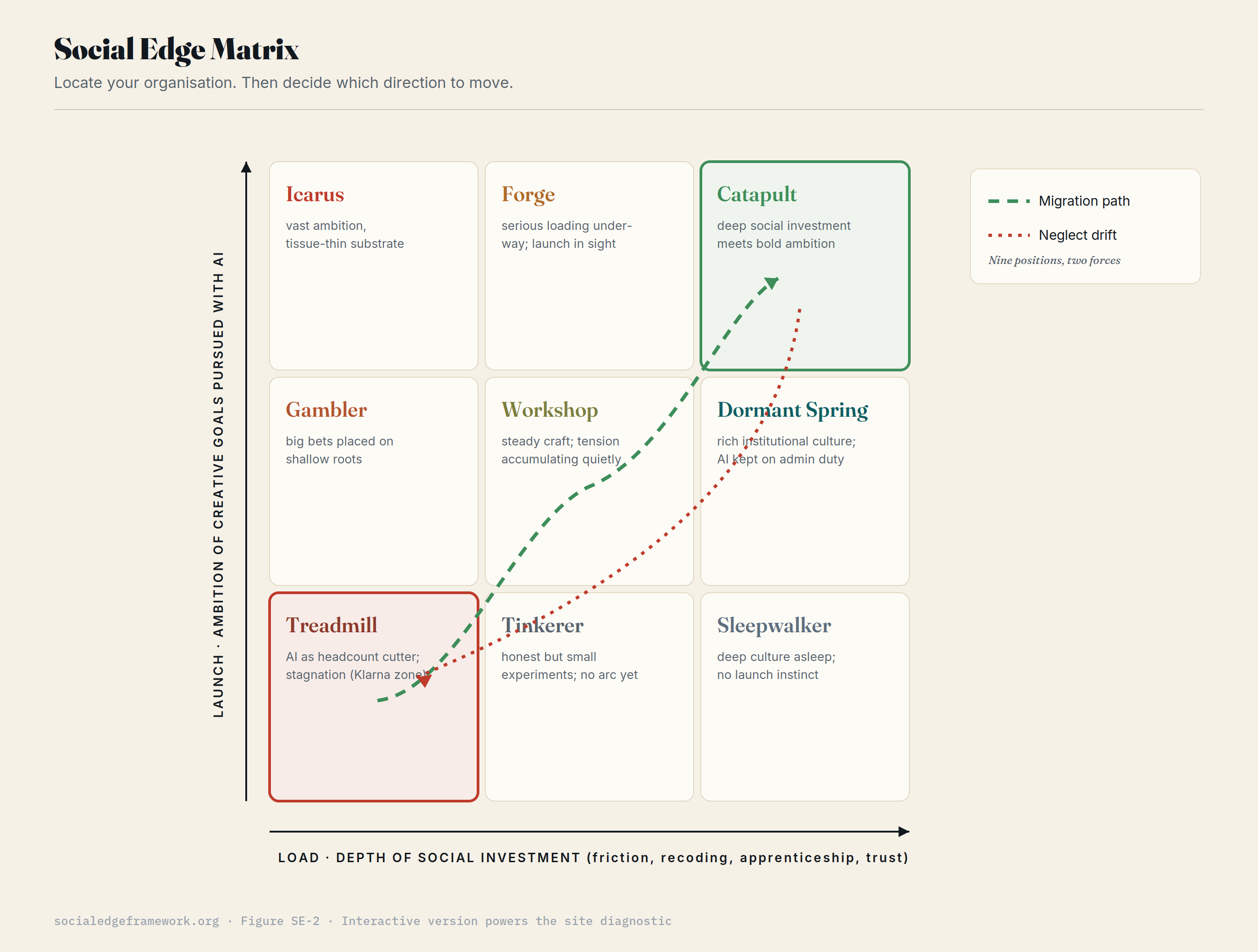
Two axes produce nine positions. The load axis measures depth of social investment: friction, recoding, apprenticeship, trust. The launch axis measures the ambition of what AI is being used to attempt. Locate your organisation honestly — the diagnostic will do it for you in four minutes — then plan movement along the migration path: load first, then launch. Watch for neglect drift: the recoil that pulls even well-positioned organisations back toward the Treadmill when social investment erodes. Four archetype names come from the founding essays (Treadmill, Icarus, Dormant Spring, Catapult); the remaining five are working names pending sign-off and are flagged as such in section 3.6.
Catapult Curve
Figure SE-1 · Social Edge Catapult
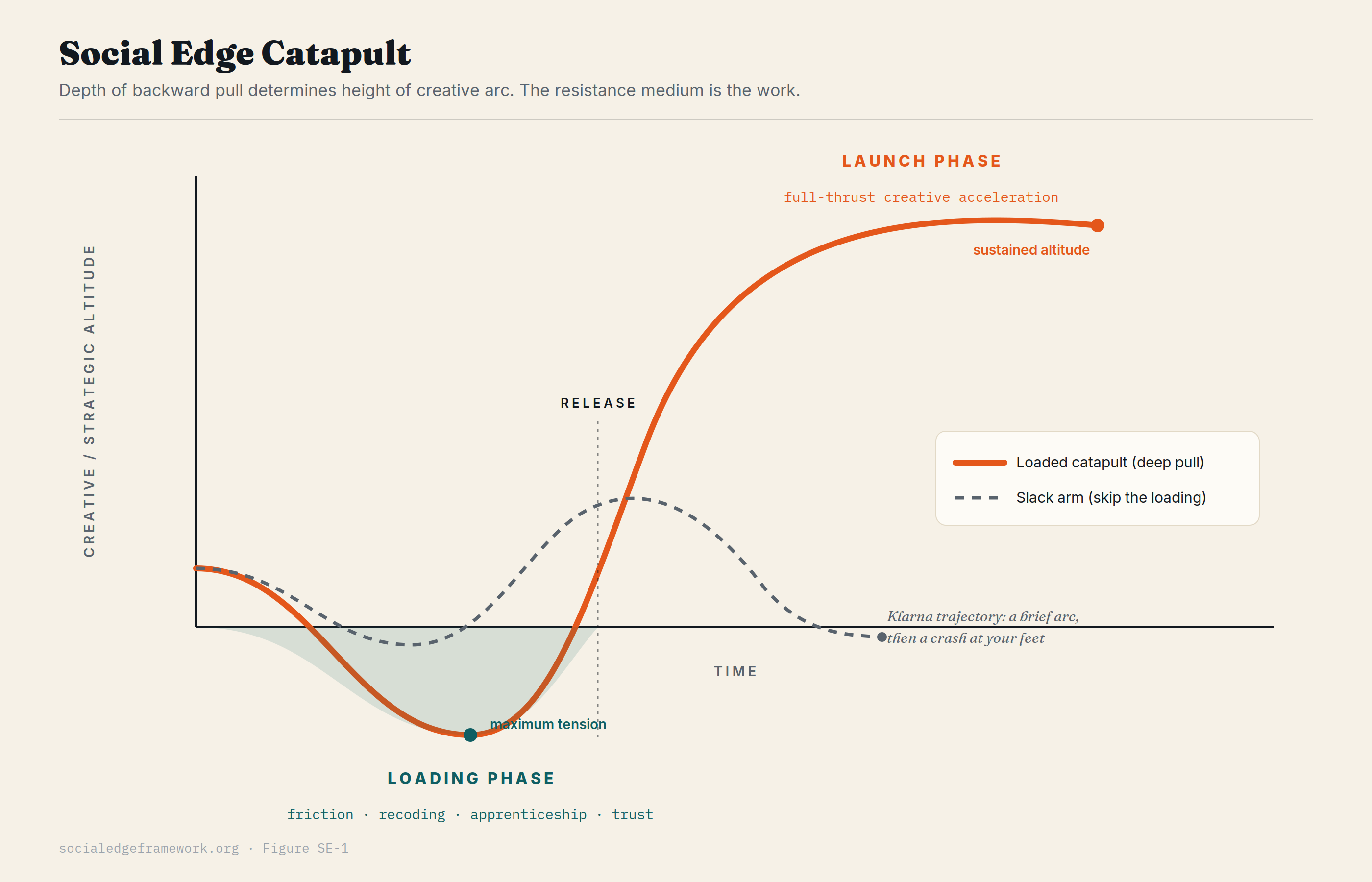
The strategic logic in one drawing. Organisations that invest in productive friction, recode legacy workflows for human-with-AI collaboration, deepen apprenticeship, and build trust architectures are loading the arm. Those that skip the loading launch slack and get the Klarna trajectory: a brief arc, then a crash. Method: name your three deepest loading mechanisms; if you cannot, you are on the dashed line.
Kill Zone / Fortress Map
Figure SE-3 · Kill Zone / Relational Fortress Map
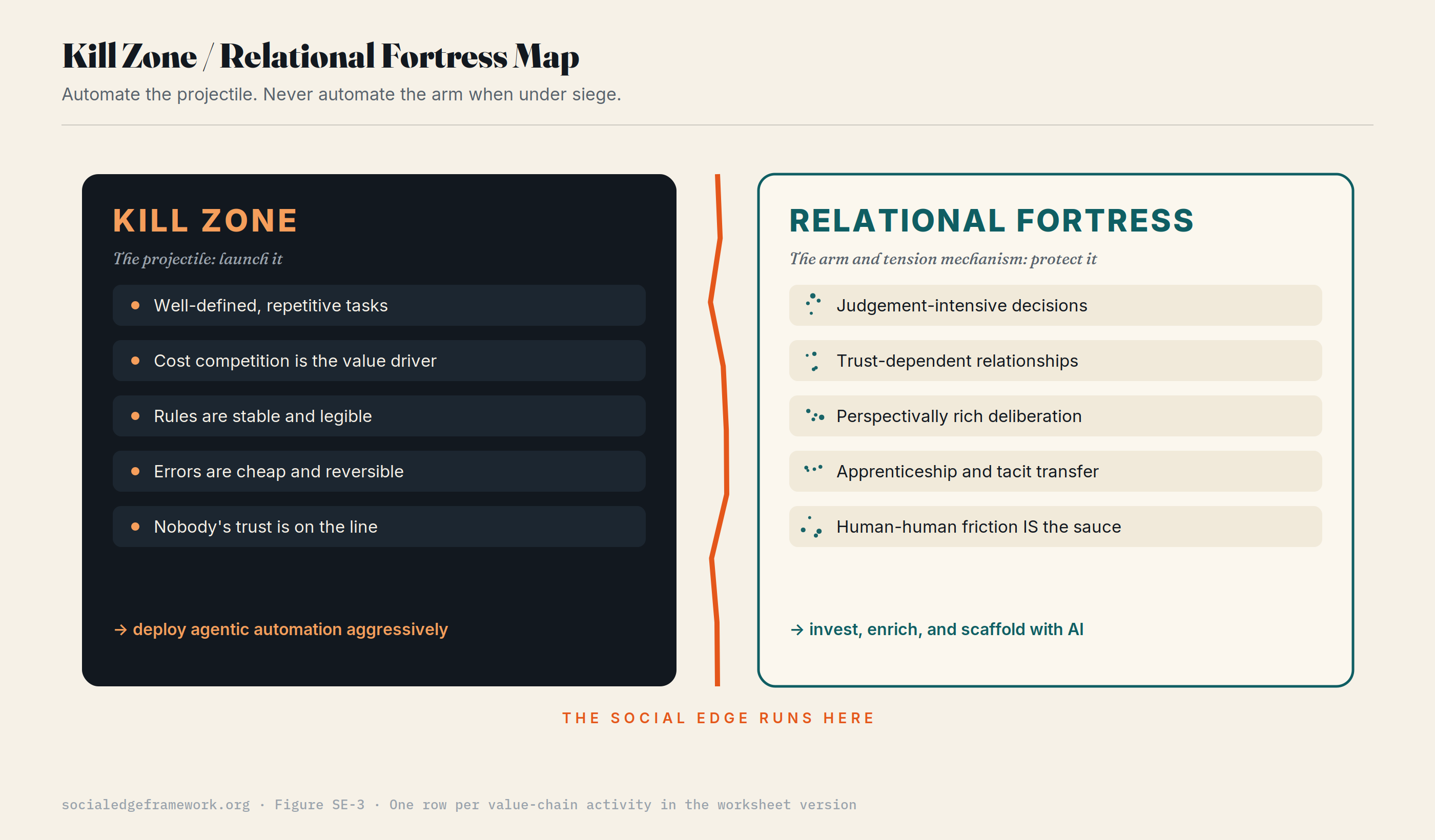
For every activity in the value chain, ask which side of the seam it belongs to. Kill zone: well-defined, repetitive, cost-competitive — the projectiles you launch with agentic automation. Relational fortress: judgement-intensive, trust-dependent, perspectivally rich — the arm and tension mechanism of the catapult itself. The rule that survives every workshop: automate the projectile; never automate the arm when under siege.
Four Ds
Figure SE-4 · Four Ds of Enriched Work
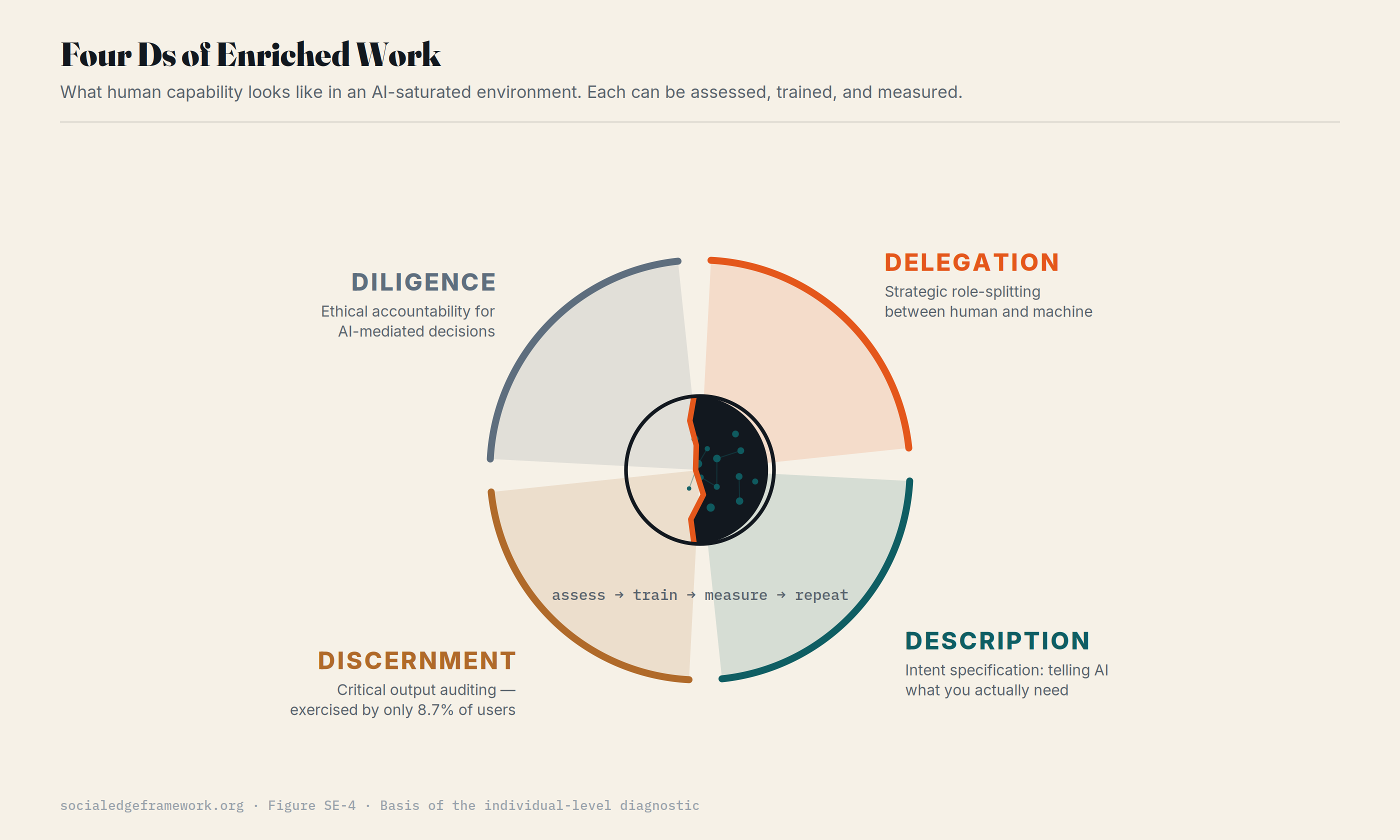
What enriched human work looks like in an AI-saturated environment. Delegation: strategic role-splitting between human and machine. Description: intent specification — telling the machine what you actually need. Discernment: critical output auditing, currently exercised by 8.7 per cent of users. Diligence: ethical accountability for AI-mediated decisions. The team-level exercise: score each member one to five on each D, then compare the map against the fortress activities they own.
Convex Leadership Test
Figure SE-5 · Convex and Concave Leadership
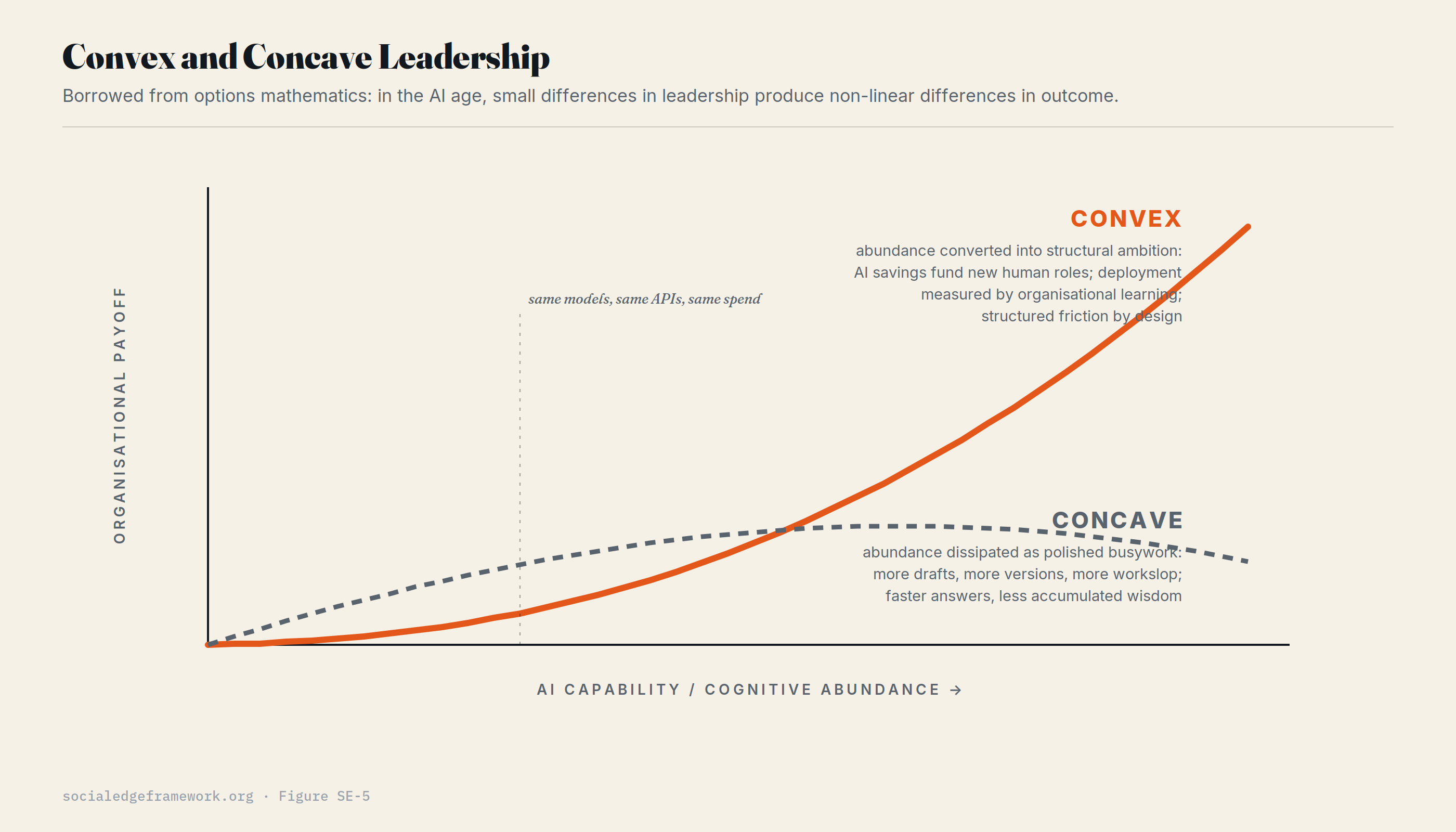
Borrowed from options mathematics. Convex leaders convert cognitive abundance into structural ambition: AI savings fund new human roles, deployment is measured by organisational learning, and friction is designed in. Concave leaders dissipate abundance as polished busywork — more drafts, more versions, more workslop — and their firms produce faster answers while accumulating less wisdom. The test is a five-question checklist in the worksheet; three or more concave answers is a red flag.